Coffee at Gail's, Upper Bridge Street

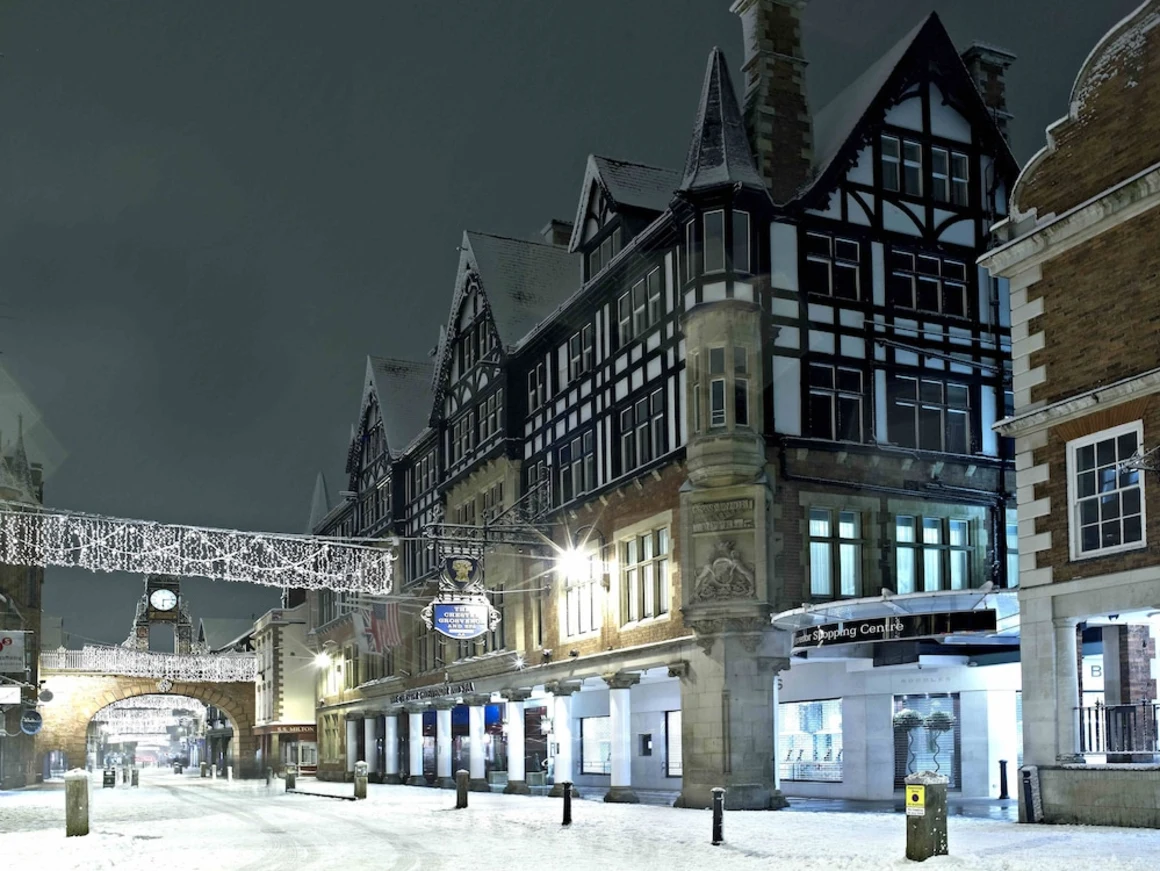
Begin with intention. Gail's Bakery on Upper Bridge Street is an ideal starting point — excellent single-origin coffee, proper sourdough, and a beautiful building on one of Chester's most architecturally rewarding streets. Upper Bridge Street is part of the original Roman Via Principalis, the main axis of the fortress. The medieval black-and-white houses that line it now rest on Roman foundations two thousand years old. Settle in, let the city come alive around you, and allow the particular quiet of Chester in the early morning to set the tone for the day.


Walking the Roman Walls


Chester's walls are the most complete Roman defensive circuit in Britain — two miles of continuous walkway enclosing the ancient city, built by the Second Augustan Legion and added to by every subsequent century. From Bridge Street, pick up the rampart walk heading north and follow it the full circuit: the northern wall above the canal; the Phoenix Tower where Charles I watched his army defeated at the Battle of Rowton Moor in 1645; the sweep south past the Cathedral and back to the Eastgate.
The full circuit takes about forty-five minutes at a relaxed pace. The views from the walls — over the city's medieval roofscape, out to the Welsh hills on clear days, and down into the perfectly preserved street grid below — are among the finest urban views in England. This is not a museum experience. This is simply a walk on living history.
No other city in England preserves its Roman circuit so completely. Walking Chester's walls is to feel history as a physical thing — not behind glass, but under your feet.
— Chester Heritage Trust
Chester Cathedral
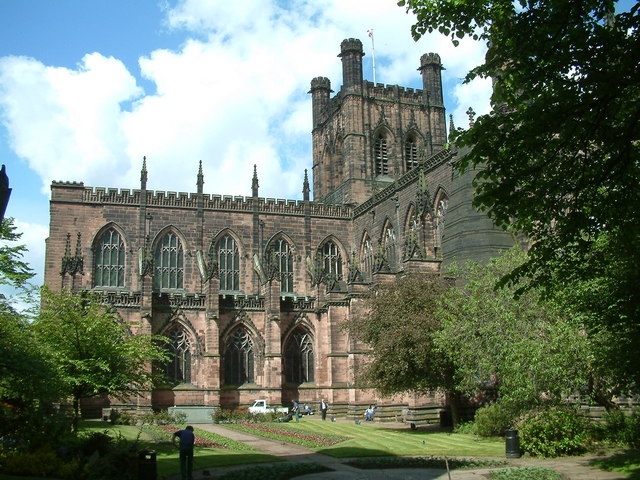
Descend from the walls at the Eastgate and enter the Cathedral precincts. Chester Cathedral is not the grand Gothic set-piece of Ely or Lincoln — it is something more intimate and, in its own way, more affecting: a sandstone Norman nave of great solidity, choir stalls carved with medieval misericords of extraordinary invention, and an enclosed cloister garth that functions as one of the finest quiet spaces in the north of England.
Allow at least thirty minutes. Examine the choir stalls carefully — the misericords beneath the hinged seats depict everything from mythical beasts to scenes of medieval daily life with a wit and precision that has not dimmed in seven hundred years. The Cathedral is free to enter; a suggested donation supports its continued care.

The Roman Amphitheatre

A five-minute walk from the Cathedral, just outside the southern wall on Little St John Street, lies one of Britain's most significant Roman monuments: the Chester Amphitheatre. Built in the late first century AD, it was the largest Roman amphitheatre in Britain, capable of holding up to 7,000 spectators — soldiers of the Twentieth Legion watching gladiatorial combat and military exercises on the very ground where you now stand.
Only the northern half has been excavated; the southern section remains beneath the adjacent streets. What is visible — the great curved outline of the stone seating banks, the passageways beneath — is extraordinary. English Heritage manages the site; entry is free. The juxtaposition of this ancient arena with the medieval walls rising immediately behind it is one of the most quietly remarkable sights in England.
The largest Roman amphitheatre in Britain — built to seat seven thousand, in use for three hundred years, forgotten for fifteen centuries, and rediscovered beneath a Chester convent in 1929.
— English Heritage

Lunch at Chester Market


Chester's revived indoor market on Princess Street is the finest place to eat lunch in the city. The new market hall brings together an exceptional collection of independent traders — proper fish and chips, excellent Vietnamese street food, artisan pizza, Welsh cheese counters, and much more — in a single space that hums with life from mid-morning through the early afternoon.
The format invites exploration: take a slow circuit of the stalls before committing, pick up a drink from one counter and food from another, and find a table in the central hall. This is Chester eating as it should be — informal, sociable, and genuinely delicious. The market is covered, making it the right place to lunch whatever the weather.

The Eastgate Clock

Return to the walls at the Eastgate — the principal gate of the Roman fortress, still on the exact alignment of the original Roman road — and climb to the clock that has marked the eastern entrance to Chester since 1899. The Eastgate Clock was erected to commemorate Queen Victoria's Diamond Jubilee, and it remains the most photographed clock face in England after Big Ben.
The view from the Eastgate along Eastgate Street — the medieval Rows receding into the distance, the Cathedral tower rising above the roofline, the pedestrianised street below full of the afternoon — is one of the great urban compositions in England, and it changes with the light at every hour. Spend a moment here before walking east along the walls toward the Groves.

The Groves & River Dee

End the day as Chester should always be ended: at the water. The Groves is the riverside promenade on the south bank of the Dee, reached in five minutes from the Eastgate by descending the walls at the Water Tower and walking through the old riverside quarter. On a fine afternoon it is one of the most pleasant stretches of riverside in England: broad, tree-lined, with rowing boats for hire, river cruises departing from Groves Pier, and the medieval walls rising behind the weir.
The ice cream stop here is not optional — it is the correct conclusion to this particular day. The vendors along the Groves have been supplying the same service since the Victorian era. Sit on a bench above the weir, watch the water, and reflect on a city that has been doing exactly this, on this same river, for the better part of two thousand years.