
Basic facts
Club Overview
- Founded
- 1885 (as Chester FC)
- Renamed Chester City
- 1983
- Dissolved
- March 2010
- Country
- England
- City
- Chester, Cheshire
- Colours
- Blue and white
Home Grounds
- Faulkner Street, Hoole
- 1885–1898
- Old Showground, Hoole
- 1898–1899
- Whipcord Lane
- 1901–1906
- Sealand Road
- 1906–1990
- Moss Rose, Macclesfield (shared)
- 1990–1992
- Deva Stadium
- 1992–2010
Main Trophies & Honours
- Cheshire County League
- 3 (1921–22, 1925–26, 1926–27)
- Welsh Cup
- 3 (1908, 1933, 1947)
- Conference National (as Chester FC, reformed club)
- 1 (2003–04, returned to Football League)
- Cheshire Senior Cup
- Multiple victories from 1895
- League Cup
- Semi-finalists 1974–75
Club Records
- Most League Appearances
- Ray Gill — 406 (1951–1962)
- Top League Goalscorer
- Stuart Rimmer — 135 Football League goals
- Record Victory
- 12–0 v York City, January 1936 (Third Division North)
- Record Defeat
- 2–11 v Oldham Athletic, January 1952
- Highest Home Attendance
- 20,500 v Chelsea, January 1952 (FA Cup)
- Football League Seasons
- 69 (1931–2000; 2004–2009)
- Times re-elected to Football League
- 7
History
Chester City Football Club is one of the more melancholy stories in English football — a club that spent 125 years trying to escape the lower reaches of the Football League, occasionally threatened to break free, and ultimately collapsed under the weight of financial mismanagement before its supporters could save it. Their story is inseparable from the story of Chester itself: a border city, neither fully English nor Welsh in character, always looking across at bigger neighbours.
Founding and early years (1885–1931)
Chester Football Club was founded in August 1885 as an amalgamation of two local clubs — Chester Rovers and Old King's Scholars. They initially played at Faulkner Street in the Hoole district of the city, competing only in friendlies for their first five years before joining the Combination League in 1890.
The club won their first senior trophy — the Cheshire Senior Cup — in 1895, and spent the next decade and a half moving grounds and gradually improving. They relocated to Sealand Road in 1906–07, establishing the home that would serve them for over eight decades. In 1908 they won the Welsh Cup for the first time, defeating Connah's Quay 3–1, and the following season won the Combination League title, losing only two games out of 30 all season.
After joining the Lancashire Combination in 1910 and gaining promotion from its second division in their first season, Chester entered the Cheshire County League in 1919 and dominated it, winning the championship three times in five seasons: 1921–22, 1925–26, and 1926–27. Despite this consistent success, the club's ambition was always the Football League. After failed applications in 1928 and 1929, Chester hired Charlie Hewitt as manager in 1930 — and in 1931, with Hewitt's team having scored 170 goals in 42 league games, Chester were elected to the Third Division North of the Football League, replacing Nelson FC.
Football League years: the early decades (1931–1974)
Chester's first 40 years in the Football League were characterised by a persistent inability to escape the lower divisions, tempered by occasional moments of cup drama. They were placed in the newly created Fourth Division in 1958 when the Football League was reorganised — a division they would remain largely stuck in for the next two decades.
Their record victory came in January 1936 — a 12–0 demolition of York City in the Third Division North, a scoreline that remains the highest winning margin in Chester's history. Their highest-ever attendance was recorded in January 1952, when 20,500 crammed into Sealand Road for an FA Cup tie against Chelsea.
The arrival of South African manager Peter Hauser in 1963 began to change the club's fortunes. In 1964–65 all five Chester forwards scored 20 goals in a season — a unique achievement — as the club scored 119 league goals, though they narrowly missed promotion. The long wait for Chester's first Football League promotion came under manager Ken Roberts in 1974–75, when the club finished fourth in the Fourth Division and pipped Lincoln City to promotion on goal average.
The League Cup semi-final of 1975
The 1974–75 season is the most celebrated in Chester City's history, and one of the most remarkable in English cup football. In the League Cup — then a competition of genuine prestige — Chester beat Walsall, Blackpool, and Preston North End before drawing Football League champions Leeds United at home in the fourth round.
"Two goals from John James and one from Trevor Storton gave Chester a 3–0 win over the defending league champions."
Fourth Round, League Cup, 1974–75What followed ranks among the greatest upsets in the competition's history. In the next round, Chester beat Newcastle United after a home replay to set up a semi-final against Aston Villa. Brian Little's late goal in the second leg at Villa Park sealed a 5–4 win for the eventual cup winners — ending Chester's greatest cup run.
The Alan Oakes era (1976–1982)
Under former Manchester City midfielder Alan Oakes, Chester consolidated their position in the Third Division and enjoyed two excellent FA Cup runs — reaching the fifth round in both 1976–77 and 1979–80. In 1978 they finished fifth in the Third Division — their best position since the lower divisions were reorganised — missing promotion by two points.
Sealand Road sold, the Deva Stadium, and financial troubles (1983–2000)
Chester added the "City" suffix to their name in 1983, reflecting the city's status, though it came at a time when the club's finances were deteriorating. Through the 1980s, Chester yo-yoed between the Third and Fourth divisions, with Stuart Rimmer — who would become the club's all-time leading Football League scorer with 135 goals — providing most of the goals.
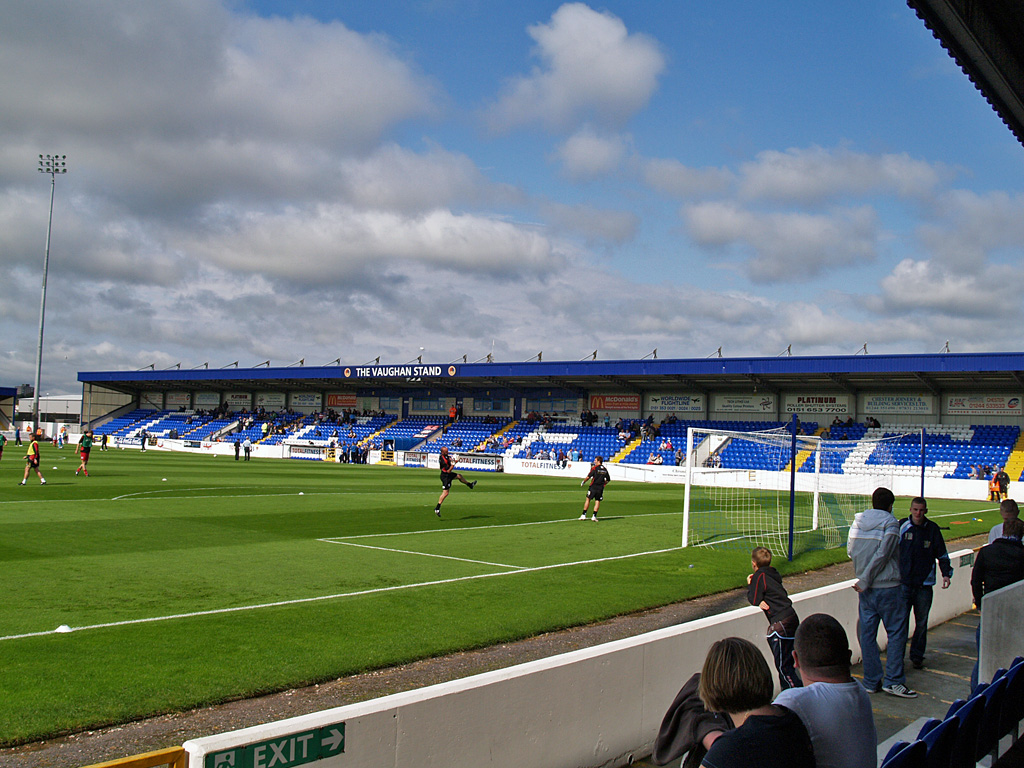
The defining financial crisis of this period came in 1990, when Sealand Road was sold to pay off debts. Chester were forced to play two full seasons at Macclesfield Town's Moss Rose ground while a new stadium was built in the city. The Deva Stadium — named after Chester's Roman name, Deva Victrix — opened in 1992, straddling the Welsh border on Bumpers Lane. Remarkably, the halfway line of the pitch crosses the England-Wales boundary, making it one of only two football grounds in the world to span two countries.
Graham Barrow led the club back to Division Two in 1994. Former Everton and Wales captain Kevin Ratcliffe took charge and led Chester to the play-offs in 1997. But the late 1990s brought fresh financial crisis: the club entered administration in 1998–99 and nearly folded entirely. An American businessman, Terry Smith, purchased the club in 1999 and installed himself as manager — a period widely regarded as the lowest point in the club's history. Chester were relegated to the Football Conference in 2000 after 69 consecutive seasons in the Football League.
Conference years and return to the League (2000–2004)
Smith sold the club to Liverpool businessman Stephen Vaughan in October 2001, and the appointment of Mark Wright as manager stabilised the club. In 2003 Chester reached the Conference play-off semi-finals, losing to Doncaster Rovers on penalties. The following season, built around a strong defence and the 49-goal partnership of Daryl Clare and Darryn Stamp, Chester won the Conference National title with only four defeats in 42 games — their first championship in 77 years. A 1–0 victory over Scarborough in front of a capacity crowd at the Deva Stadium confirmed promotion back to the Football League.
Final Football League years and dissolution (2004–2010)
The four seasons back in the Football League were marked by a succession of managers and recurring battles against relegation. In May 2009 Chester were relegated to the Football Conference for the second time, their last Football League game a 2–1 home defeat to Darlington on 2 May 2009.
What followed was swift and catastrophic. Chester was placed into administration in the summer of 2009 with debts of £7 million. The Vaughan family controversially bought the club back, incurring a 10-point deduction that rose to 25 points. In January 2010, HMRC issued a winding-up petition for £29,000. The Football Conference suspended the club for breaching financial rules and cancelling fixtures. On 8 March 2010, at a hearing lasting less than one minute, Chester City FC was formally wound up in the High Court. 125 years of history ended.
At a hearing lasting less than one minute, 125 years of history ended.
High Court, 8 March 2010Supporters immediately organised the formation of a new club. Chester FC was officially established in May 2010 as a community-owned club, beginning life in the eighth tier of English football. Within three seasons they had won promotion to the Football Conference, and the club continues today — the direct descendant of Chester City in spirit if not in law.
Prominent players
Ray Gill (406 league appearances, 1951–1962), Stuart Rimmer (135 Football League goals — all-time record), John James (League Cup hero, 1975), Trevor Storton, Ian Rush (briefly, early career), Michael Branch, Kevin Ratcliffe (manager and former player), Gary Bennett, Cyrille Regis (brief spell), Daryl Clare, Darryn Stamp.
The Chester–Wrexham derby
As a border club, Chester held a unique position in English football — their closest geographical rivals were Wrexham AFC in Wales. The cross-border derby between the two clubs was one of the most geographically unusual in English football, with Chester based in England and Wrexham in Wales, yet both within the same Football League structure. Chester also participated in the Welsh Cup on invitation throughout their history, winning it three times (1908, 1933, 1947) and reaching the final on ten further occasions.
Timeline
Chester City FC — Key Dates
| 1885 | Club founded as Chester FC — amalgamation of Chester Rovers and Old King's Scholars |
| 1890 | Join the Combination League |
| 1895 | First Cheshire Senior Cup victory |
| 1906 | Move to Sealand Road — home for 85 years |
| 1908 | First Welsh Cup victory (v Connah's Quay, 3–1) |
| 1909 | Win the Combination League title |
| 1921–27 | Win Cheshire County League three times |
| 1931 | Elected to the Football League — Third Division North |
| 1933 | Second Welsh Cup victory |
| 1936 | Record victory: 12–0 v York City |
| 1947 | Third Welsh Cup victory (v Cardiff City) |
| 1952 | Record attendance: 20,500 v Chelsea (FA Cup) |
| 1958 | Placed in the newly created Fourth Division |
| 1975 | Beat champions Leeds United 3–0 in League Cup; reach semi-finals (lose to Aston Villa) |
| 1975 | First promotion: Fourth Division to Third Division |
| 1983 | Renamed Chester City FC |
| 1990 | Sealand Road sold to pay debts; play at Macclesfield for two seasons |
| 1992 | Move to the new Deva Stadium |
| 1999 | Enter administration — narrowly avoid dissolution |
| 2000 | Relegated from Football League to Conference after 69 consecutive seasons |
| 2004 | Win Conference National — return to Football League |
| 2009 | Relegated again to Conference; enter administration |
| 2010 | Wound up by HMRC — 8 March 2010. 125-year history ends |
| 2010 | Chester FC formed by supporters — phoenix club begins in eighth tier |
Chester FC Today — 2026/27 Fixtures
The old club's story ended in the High Court in 2010 — but football at the Deva Stadium didn't. Chester FC, formed by supporters within weeks of the dissolution, now play in the National League North. Here's the full 2026/27 fixture list.
Compare hotel rates in Chester before you travel — handy for evening kick-offs or a weekend built around a fixture.
| Date | Opponent | Venue | Comp. |
|---|---|---|---|
| August 2026 | |||
| Sat 29 Aug | Hereford | Away | NLN |
| Mon 31 Aug | Morecambe | Home | NLN |
| September 2026 | |||
| Sat 5 Sep | Hebburn Town | Away | NLN |
| Tue 8 Sep | Merthyr Town | Home | NLN |
| Sat 12 Sep | Buxton | Away | NLN |
| Sat 26 Sep | Worksop Town | Home | NLN |
| October 2026 | |||
| Sat 10 Oct | Bedford Town | Home | NLN |
| Sat 17 Oct | Spennymoor Town | Away | NLN |
| Sat 24 Oct | South Shields | Away | NLN |
| Tue 27 Oct | Marine | Home | NLN |
| Sat 31 Oct | Hednesford Town | Home | NLN |
| November 2026 | |||
| Sat 7 Nov | Brackley Town | Away | NLN |
| Sat 21 Nov | Macclesfield | Home | NLN |
| Tue 24 Nov | Harborough Town | Away | NLN |
| Sat 28 Nov | Radcliffe | Away | NLN |
| December 2026 | |||
| Sat 5 Dec | Oxford City | Home | NLN |
| Tue 8 Dec | Chorley | Home | NLN |
| Sat 19 Dec | King's Lynn Town | Away | NLN |
| Sat 26 Dec | AFC Telford United | Home | NLN |
| Mon 28 Dec | Southport | Away | NLN |
| January 2027 | |||
| Sat 2 Jan | Scarborough Athletic | Away | NLN |
| Sat 9 Jan | Spennymoor Town | Home | NLN |
| Sat 16 Jan | Buxton | Home | NLN |
| Sat 23 Jan | Worksop Town | Away | NLN |
| Tue 26 Jan | Harborough Town | Home | NLN |
| Sat 30 Jan | Macclesfield | Away | NLN |
| February 2027 | |||
| Sat 6 Feb | Brackley Town | Home | NLN |
| Sat 13 Feb | Hednesford Town | Away | NLN |
| Tue 16 Feb | Marine | Away | NLN |
| Sat 20 Feb | South Shields | Home | NLN |
| Tue 23 Feb | Merthyr Town | Away | NLN |
| Sat 27 Feb | Hereford | Home | NLN |
| March 2027 | |||
| Sat 6 Mar | Spalding United | Away | NLN |
| Tue 9 Mar | Darlington | Home | NLN |
| Sat 13 Mar | Hebburn Town | Home | NLN |
| Sat 20 Mar | Morecambe | Away | NLN |
| Fri 26 Mar | Southport | Home | NLN |
| Mon 29 Mar | AFC Telford United | Away | NLN |
| April 2027 | |||
| Sat 3 Apr | Scarborough Athletic | Home | NLN |
| Sat 10 Apr | Bedford Town | Away | NLN |
| Sat 17 Apr | Oxford City | Away | NLN |
| Sat 24 Apr | Radcliffe | Home | NLN |
NLN = National League North. Fixtures subject to change — see the official Chester FC fixtures page ↗ for kick-off times, ticket links and any postponements.
League record — selected seasons
| Season | League | Position | Notes |
|---|---|---|---|
| 2008–09 | Football League Two | Relegated | Relegated to Conference |
| 2007–08 | Football League Two | Mid-table | |
| 2006–07 | Football League Two | Mid-table | |
| 2005–06 | Football League Two | Mid-table | |
| 2003–04 | Football Conference | 1st | Champions — promoted to FL |
| 2002–03 | Football Conference | Play-off SF | Lost to Doncaster on pens |
| 1999–00 | Football League Third | Relegated | Relegated after 69 seasons in FL |
| 1997–98 | Football League Third | Play-offs | Under Kevin Ratcliffe |
| 1993–94 | Football League Third | Promoted | Promoted under Graham Barrow |
| 1992–93 | Football League Second | Relegated | |
| 1985–86 | Football League Fourth | Promoted | Promoted — Stuart Rimmer era |
| 1978–79 | Football League Third | 5th | Best post-war position |
| 1974–75 | Football League Fourth | 4th | First FL promotion; LC semi-final |
| 1958–59 | Third Division North | — | Placed in new Fourth Division |
| 1931–32 | Third Division North | First season | Elected to Football League |
Records & Statistics
The numbers behind 125 years of Football League history — from Sealand Road sell-outs to Stuart Rimmer's goals. Data drawn from Chester Football History, the most authoritative statistical archive of the club.
Top Attendances at Sealand Road
| 1 | 20,378 — Chelsea, FA Cup 3rd Round replay, 18 Jan 1952 (L 2–3) |
| 2= | 19,000 — Leeds United, League Cup 4th Round, 13 Nov 1974 (W 3–0) |
| 2= | 19,000 — Newcastle United, League Cup 5th Round, 18 Dec 1974 (W 1–0) |
| 2= | 19,000 — Aston Villa, League Cup Semi-Final, 22 Jan 1975 (D 2–2) |
| 5 | 18,816 — Sheffield Wednesday, FA Cup 4th Round replay, 25 Jan 1939 |
| 8 | 18,004 — Wrexham, Division 3 North, 29 Aug 1936 (W 4–1) |
The three League Cup ties of 1974–75 were recorded at ground capacity rather than an exact count. Fourteen of the top 20 attendances resulted in a win or draw — Chester regularly rose to big occasions.
All-Time Football League Goalscorers
| 1 | Stuart Rimmer — 127 goals (1985–1988, 1991–1993) |
| 2 | Gary Talbot — 83 goals |
| 3 | Frank Wrightson — 73 goals in just 89 league games (1930s) |
Rimmer's record looks all the more remarkable given he achieved it across two separate spells. Frank Wrightson's ratio of nearly a goal per game in the 1930s may never be surpassed — he scored 26 goals in a 13-game run across all competitions in 1936, including four in the record 12–0 win over York City.
All-Time Football League Appearances
| 1 | Ray Gill — 406 appearances (1951–1962) |
Over 767 players made at least one Football League appearance for Chester between 1931 and 2009. The full top-50 appearance makers — covering league starts and substitute appearances separately — are catalogued at Chester Football History.
FA Cup — Key Managerial Records
| — | Alan Oakes — 10 wins from 17 ties; reached the 5th Round twice (1977, 1980) |
| — | Frank Brown — 11 wins from 24 ties; took the club to the 4th Round replay twice |
| — | Harry McNally — 8 wins from 21 ties; managed 7 ties in a single season (1986–87) |
Chester beat top-flight Newcastle United in the 1979–80 FA Cup under Alan Oakes. In the 1932–33 FA Cup, they defeated Second Division Fulham 5–0 at Sealand Road — one of the club's greatest cup results.
Further Reading
For a far deeper dive into the statistics, match records, player profiles and archive material behind this history — including full top-50 appearance and goalscoring tables, season-by-season data and rare film footage — Chester Football History is an extraordinary resource run by historian Chas Sumner. It is the most comprehensive archive of Chester City FC that exists.
Stadium Tours & Football Experiences Nearby
Chester City FC fans — and Chester FC fans today — have always looked to the wider football landscape of the North West. Liverpool, just 45 minutes from Chester, offers some of the finest football experiences in the world. Book ahead — these sell out fast.

